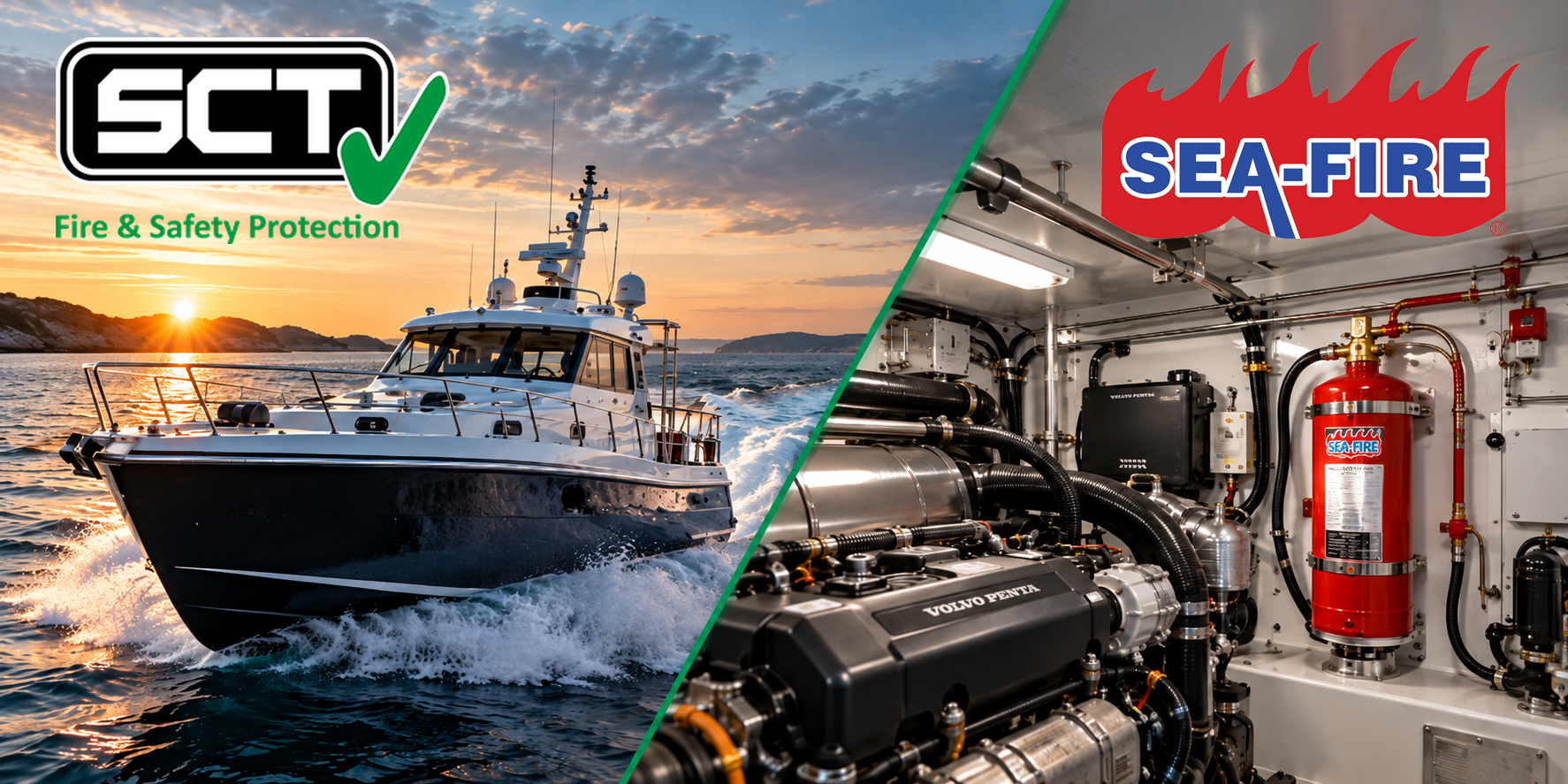
Boat engine room fire suppression is an essential consideration for vessel owners planning to protect their machinery spaces against fire. However, selecting the right system involves much more than choosing a cylinder and mounting it beside the engine.
Fuel, electrical equipment, hot surfaces and restricted access can make an engine compartment fire particularly dangerous. Furthermore, a vessel may be operating miles from shore, with limited firefighting resources and no immediate outside assistance.
A properly designed marine fire suppression system can help detect and control certain fires within a protected compartment. In some cases, automatic activation can suppress a developing fire without requiring anyone to enter the affected space.
Whether you own a leisure boat, operate a commercial fishing vessel or manage a fleet of workboats, understanding the installation requirements is essential.
In this guide, SCT Fire & Safety Protection explains eight important checks to consider before installing a boat engine room fire suppression system.
1. Check Boat Engine Room Fire Suppression Requirements
Before choosing a boat engine room fire suppression system, you must establish the fire protection requirements for your particular vessel.
For example, a privately operated motorboat, commercial fishing vessel, passenger vessel and working tug may all be subject to different safety regulations.
Important considerations include:
- The vessel’s flag state and registration.
- Vessel length and operating category.
- Construction and machinery arrangements.
- Intended use and operating conditions.
- Applicable certification and survey requirements.
In the United Kingdom, the Maritime and Coastguard Agency (MCA) publishes codes and requirements for different vessel categories. For instance, the Workboat Code Edition 3 covers small commercial workboats and pilot boats within its scope.
Fishing vessels and passenger vessels have their own applicable requirements.
Meanwhile, in the Republic of Ireland, the Marine Survey Office oversees relevant vessel safety and certification requirements. The Department of Transport also publishes a Code of Practice for the Safe Operation of Recreational Craft.
These requirements are not interchangeable. Therefore, commercial operators may need to consult the relevant surveyor, certifying authority or flag administration before selecting a fixed fire suppression system.
Importantly, marine approval for a product does not automatically mean every proposed installation is approved for every vessel.
2. Correctly Size Your Boat Engine Room Fire Suppression System
Correct compartment sizing is one of the most important considerations when selecting a boat engine room fire suppression system.
Pre-engineered systems protect defined enclosure volumes. If the protected space exceeds the system’s rated capacity, the required extinguishing concentration may not be achieved.
Example Engine Room Volume Calculation
Consider an engine compartment with the following dimensions:
- Length: 2.5 metres.
- Width: 2 metres.
- Height: 1.8 metres.
The basic rectangular volume is:
2.5 × 2 × 1.8 = 9 cubic metres (9m³).
However, marine machinery spaces rarely have perfectly rectangular dimensions. Recesses, connected spaces, ventilation arrangements and compartment geometry can affect the assessment.
Therefore, the final calculation must follow the manufacturer’s design instructions and any applicable approval conditions.
In particular, owners should not automatically deduct the space occupied by engines or other equipment unless the accepted design method permits it.
Sea-Fire Engine Compartment Coverage
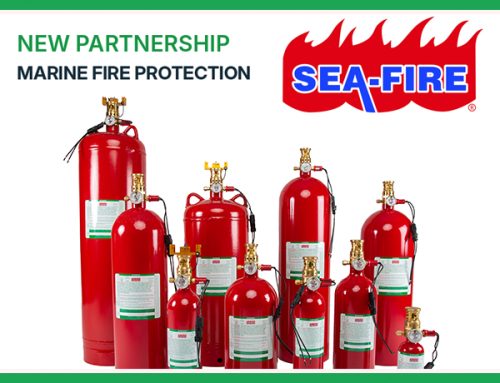
Sea-Fire offers pre-engineered marine suppression systems for different compartment sizes.
Its published NFG range includes models for protected engine compartment volumes from approximately 0.7m³ to 2.8m³. Meanwhile, the NFD range includes models covering approximately 3.5m³ to 51m³.
These figures describe the published model ranges and do not replace the manufacturer’s current selection instructions or approval requirements.
For larger or more complex machinery spaces, an engineered fire suppression system may be more appropriate.
3. Check Engine Room Ventilation and Compartment Integrity
Even a correctly sized boat engine room fire suppression system may not provide effective protection if the extinguishing agent cannot remain within the engine compartment.
Many marine gaseous fire suppression systems depend on achieving and maintaining a suitable concentration of extinguishing agent for the required period.
However, open ventilation ducts, unsealed access panels and machinery drawing air through the compartment can interfere with this process.
Before installation, the system designer should assess:
- The integrity of the protected compartment.
- Ventilation openings and ductwork.
- Access hatches, doors and removable panels.
- Powered extraction and ventilation fans.
- Air movement caused by engines and machinery.
- Any openings that require automatic or manual closure.
For example, an engine compartment with powered extraction fans may require an arrangement that stops those fans when the suppression system activates.
Furthermore, changes made after installation can affect system performance. Adding ventilation openings or modifying compartment dimensions may compromise the original design.
For this reason, a marine fire suppression installation must be considered as a complete protective arrangement rather than simply a standalone cylinder.
4. Choose the Right Marine Fire Suppression System
Not every marine engine fire suppression system uses the same extinguishing agent. Likewise, not every agent is suitable for every fire hazard.
Marine engine compartments may contain diesel, petrol, lubricating oils, electrical equipment and other machinery. Consequently, the system designer must assess the hazards before selecting suitable equipment.
Clean-Agent Marine Fire Suppression Systems
Sea-Fire offers marine fire suppression systems using the clean extinguishing agent FK-5-1-12.
This agent is electrically non-conductive and is suitable for certain applications where protecting machinery and electrical equipment is important.
Unlike dry powder, clean-agent suppression does not leave a powder residue throughout the protected compartment following discharge.
However, this does not mean that a single clean-agent system can control every type of onboard fire.
For example, a conventional machinery-space suppression system should not automatically be considered suitable for lithium-ion battery thermal runaway. Battery-related hazards require their own assessment and appropriately tested protection solutions.
Ultimately, the correct extinguishing agent must suit the identified fire hazards, compartment arrangement and applicable vessel approval requirements.
5. Choose Automatic or Manual Fire Suppression Activation
Another important boat engine room fire suppression consideration is how the system will activate during an emergency.
Depending on the equipment and vessel requirements, the installation may incorporate automatic activation, manual release or a combination of both.
Automatic Fire Suppression
Certain Sea-Fire pre-engineered systems use heat-sensitive activation mechanisms.
When the temperature at the sensing device reaches its specified activation range, the system discharges extinguishing agent into the protected compartment.
This can be particularly useful in enclosed engine spaces that crew members do not continuously occupy.
As a result, automatic activation may help address a developing fire before anyone discovers it.
Manual Fire Suppression Activation
Manual activation allows an operator to initiate discharge using a suitable remote release arrangement.
Depending on the vessel and system specification, this may provide an additional activation method or form part of a manually operated installation.
Some Sea-Fire systems combine automatic and manual release capabilities.
However, automatic activation is not universally permitted or appropriate for every machinery space.
Therefore, the designer must consider the vessel category, compartment occupancy, system approval and operating procedures before deciding on the activation arrangement.
6. Plan Engine and Ventilation Shutdown for Fire Suppression
Engine and ventilation shutdown arrangements can play an important role in the performance of boat engine room fire suppression.
For example, imagine a suppression system discharging while the engine and powered ventilation equipment continue operating.
Air movement could remove extinguishing agent from the compartment. Consequently, the system may struggle to maintain the concentration required to control the fire.
Depending on the installation, suitable shutdown arrangements may therefore be necessary.
Sea-Fire offers engine shutdown and associated control equipment for integration with compatible suppression systems. Its pre-engineered product information also identifies pressure switches for supervision and related control functions.
However, shutdown arrangements must account for more than extinguishing agent retention.
For instance, stopping an engine could affect vessel manoeuvrability or other essential functions.
Therefore, a competent designer must establish the correct arrangements using the vessel’s applicable requirements, machinery configuration and selected suppression system instructions.
Engine and ventilation shutdown requirements should never be based on assumptions about how every vessel operates.
7. Check Marine Fire Suppression Monitoring and Alarms
A boat engine room fire suppression system should provide suitable information about its condition and operation.
After all, installing a system is only the beginning. Vessel operators must understand whether the equipment is ready for service and what happens when it activates.
Depending on the selected equipment, monitoring features may include:
- Cylinder pressure supervision.
- System discharge indications.
- Audible and visual alarms.
- Connections to vessel fire detection equipment.
- Integration with onboard monitoring and control systems.
Sea-Fire’s marine product range includes compatible fire detection and control equipment that can integrate with selected suppression installations.
For commercial operators, clear monitoring arrangements are particularly important when multiple crew members share responsibility for a vessel.
Similarly, fleet operators may manage vessels with different machinery arrangements and fire protection equipment.
Consequently, accessible instructions and appropriate crew familiarisation are essential.
Crew members should understand where the controls are located, what the system indications mean and which procedures to follow after a fire or discharge.
8. Plan Your Marine Fire Suppression Installation and Maintenance
A boat engine room fire suppression system is a long-term safety installation rather than a one-off equipment purchase.
Therefore, vessel owners should consider installation quality, commissioning, documentation and future servicing requirements before selecting a system.
Depending on the equipment and vessel, important documentation may include:
- System manufacturer and model details.
- Protected compartment volume calculations.
- Installation and commissioning records.
- Operating and emergency instructions.
- Inspection and maintenance schedules.
- Previous servicing and repair information.
Understanding Servicing Requirements
Marine fire suppression servicing requirements vary according to the system model and applicable vessel regulations.
For example, Sea-Fire’s published NFG/NFD owner documentation specifies periodic cylinder weight and pressure inspections, including a minimum six-monthly interval for those particular checks.
However, this must not be interpreted as a universal servicing schedule for every Sea-Fire system or vessel.
Additional inspection, maintenance and survey requirements may also apply.
Furthermore, only appropriately authorised and competent personnel should handle or service pressurised cylinders and activation mechanisms.
Owners should never attempt to dismantle, disconnect or test this equipment without the necessary competence and procedures.
Planning for Future Access
Before installation, consider whether technicians will be able to access the equipment for inspections and maintenance.
For instance, placing a cylinder where its condition cannot be properly checked may create unnecessary difficulties later.
By considering future maintenance during the design stage, vessel owners can make their equipment easier to manage throughout its working life.
For further guidance, read our marine fire suppression servicing and maintenance guide.
What About Existing or Older Marine Fire Suppression Systems?
Not every vessel requires a completely new marine fire suppression installation.
Some owners already have fixed suppression equipment but remain uncertain about its condition, suitability or maintenance history.
This is particularly relevant when purchasing a second-hand vessel, undertaking an engine refurbishment or changing how a boat will be used.
For example, an existing system may require assessment if:
- Installation or servicing documentation is missing.
- The protected engine compartment has changed.
- The cylinder shows signs of corrosion or damage.
- The equipment has previously discharged.
- The maintenance history cannot be established.
- The original system may no longer suit the vessel’s requirements.
Replacement may be necessary when equipment is damaged, discharged, unsupported or unsuitable for the protected space.
However, age alone does not establish a universal replacement deadline.
Instead, the correct decision depends on the cylinder specification, system design, manufacturer instructions and applicable requirements.
Consequently, a professional assessment before purchasing replacement equipment can help identify genuine safety concerns and avoid unnecessary expenditure.
Marine Fire Suppression Installation Across Northern Ireland and the Republic of Ireland
SCT Fire & Safety Protection is an appointed dealer and installer for Sea-Fire Europe.
Through this relationship, SCT supports marine fire suppression enquiries across Northern Ireland and the Republic of Ireland.
Our marine fire protection solutions may be suitable for a range of applications, including:
- Leisure boats and motorboats.
- Private yachts.
- Commercial fishing vessels.
- Workboats and marine service vessels.
- Other commercial marine applications.
However, the suitability of any proposed Sea-Fire system depends on the vessel, its operating requirements and the relevant equipment approvals.
Whether you are planning a new installation, replacing an ageing system or reviewing protection during an engine room upgrade, getting the specification right from the outset is essential.
SCT can discuss your vessel’s requirements, consider suitable Sea-Fire equipment and explain the next steps towards installation.
In addition, our team can discuss the manufacturer’s inspection requirements and available arrangements for ongoing support.
To learn more, read about SCT’s appointment as a Sea-Fire Europe dealer and installer.
You can also explore our wider fire suppression solutions for other specialist applications.
Speak to SCT About Your Boat Engine Room Fire Suppression Requirements
Are you planning a new boat engine room fire suppression installation or considering an upgrade to an existing system?
Contact SCT Fire & Safety Protection to discuss your vessel, machinery compartment and fire suppression requirements.
We welcome enquiries from private boat owners, commercial operators, marine engineers, boatyards and fleet managers throughout Northern Ireland and the Republic of Ireland.
To help us assess your enquiry, please provide any available vessel details, machinery compartment dimensions and information about existing fire protection equipment.
Our team can then discuss suitable next steps and available installation options.
Telephone: 028 7744 5079
Email: info@sct-ni.com
Online: Contact the SCT Team
SCT Fire & Safety Protection – Protecting People, Property & Assets.