Yacht generator fire suppression is an important part of protecting auxiliary machinery spaces aboard modern vessels. Although main propulsion engines often receive the most attention, onboard generators also present fire risks involving fuel, electrical equipment and hot surfaces.
Marine generators provide electrical power for lighting, refrigeration, air conditioning and other onboard systems. On larger motor yachts and commercial vessels, they may operate for extended periods, sometimes while the main propulsion engines are switched off.
However, generators can introduce several fire hazards. Fuel connections, exhaust systems and electrical components often sit within confined spaces, making a fire difficult to access or control.
At SCT Fire & Safety Protection, we support marine fire suppression enquiries throughout Northern Ireland and the Republic of Ireland. As an appointed Sea-Fire Europe dealer and installer, we help customers explore suitable fixed fire suppression options for enclosed machinery spaces.
This guide explains generator fire risks, available suppression technologies, installation considerations and the factors that influence the correct protection arrangements.
Why Yacht Generator Fire Suppression Matters
Marine generators operate in demanding environments. However, their installation can create several fire safety challenges.
A typical onboard generator combines an engine, alternator, fuel supply, exhaust system and electrical connections within a relatively small area.
Depending on the vessel, the generator may sit inside a sound-insulated enclosure, alongside the propulsion engines or within a separate machinery compartment.
Each arrangement creates different fire risks and may require a different approach to protection.
Heat, Fuel and Electrical Equipment
Generators produce considerable heat during normal operation. Exhaust components and engine surfaces can reach high temperatures, so installers must keep them suitably separated from combustible materials.
Fuel lines, hoses and connections also require regular checks. For example, a fuel leak that reaches a hot surface could cause a serious fire.
Electrical faults create another possible ignition source, particularly when wiring deteriorates or connections become damaged.
Therefore, owners should prioritise correct installation and routine maintenance. Fire suppression provides an additional layer of protection rather than a substitute for safe machinery.
Restricted Access During a Fire
Some yacht generators sit in compartments that are difficult to reach, especially during an emergency.
Opening an enclosure or machinery hatch during a fire can expose someone to heat, smoke and flames. Furthermore, introducing additional oxygen may increase the intensity of the fire.
A correctly specified fixed suppression system can deliver extinguishing agent into the protected space without requiring someone to open the compartment during the incident.
As a result, yacht generator fire suppression can provide valuable protection where machinery operates unattended or access is restricted.
Does a Yacht Generator Need a Separate Fire Suppression System?
Not necessarily. The answer depends on the generator’s location and the protection already available aboard the vessel.
For example, a generator positioned within the main engine room may fall inside the protected volume of an existing fixed fire suppression system.
However, the system designer must confirm that the existing arrangement provides suitable protection. The presence of a suppression cylinder does not automatically mean every item of machinery has adequate coverage.
A generator inside a separate sound-insulated enclosure may present different conditions from equipment exposed to the wider engine room.
In particular, enclosure walls, airflow and ventilation can affect how an extinguishing agent reaches the fire.
Similarly, a generator in a completely separate compartment may require its own fire protection assessment.
Shared Engine Room vs Separate Generator Compartment
Consider two common yacht generator installations.
Shared engine room: A motor yacht has a generator installed beside its propulsion engines within one enclosed machinery space. A suitable fixed system may protect the combined space if its capacity, discharge arrangement and associated controls meet the installation requirements.
Separate generator compartment: The generator sits within its own sound-insulated enclosure or independent machinery space. In this situation, owners cannot assume that the main engine room system also protects the generator.
The correct solution depends on compartment boundaries, fire hazards, equipment approvals and the vessel’s requirements.
Consequently, owners should consider yacht generator fire suppression as part of the vessel’s overall fire protection strategy rather than treating it as an isolated equipment purchase.
Types of Yacht Generator Fire Suppression Systems
Several marine fire suppression technologies can protect suitable enclosed machinery spaces.
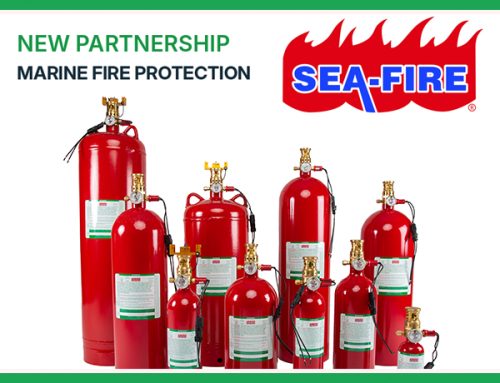
Sea-Fire Europe’s product range includes pre-engineered clean-agent systems, engineered systems and compact aerosol-based solutions.
However, the correct technology depends on the protected space, identified hazards, system approvals and operating conditions.
Sea-Fire Pre-Engineered Clean-Agent Systems
Sea-Fire’s NFG and NFD ranges use FK-5-1-12 extinguishing agent and are designed for defined enclosed machinery compartment volumes.
The published European product range includes:
- NFG systems: Approximately 0.7m³ to 2.8m³ of protected compartment volume.
- NFD systems: Approximately 3.5m³ to 51m³ of protected compartment volume.
These are indicative product ranges rather than a substitute for current manufacturer sizing data.
Depending on the model, the systems provide automatic heat activation. Designated versions also offer manual release options.
Furthermore, the manufacturer specifies machinery shutdown requirements to help maintain the necessary extinguishing-agent concentration.
Before choosing a system for yacht generator fire suppression, the designer must confirm that the equipment, approval and discharge arrangement suit the enclosure and its operating conditions.
Compact Aerosol Fire Suppression Systems
Installation space is often limited aboard yachts, particularly around auxiliary machinery.
Sea-Fire’s AT-Series provides an alternative approach using condensed aerosol fire suppression technology.
According to Sea-Fire Europe, these systems protect defined enclosure volumes and incorporate heat-responsive automatic activation. Suitable configurations may also offer manual activation.
Unlike conventional pressurised gaseous systems, the AT-Series uses a non-pressurised generator containing aerosol-forming material.
When activated, it produces a potassium-based aerosol intended to suppress a fire within the protected enclosure.
Its compact design may suit installations where space is restricted.
However, an aerosol system is not automatically suitable for every marine generator. The designer must consider the fire hazards, compartment conditions, equipment sensitivity and relevant marine approvals.
Additionally, aerosol discharge characteristics, possible residue and post-discharge procedures require careful consideration.
Correctly Sizing a Marine Generator Fire Suppression System
Correct compartment sizing is essential for effective yacht generator fire suppression.
Designers must select fixed systems according to the space they need to protect. For pre-engineered equipment, the compartment volume is a particularly important factor.
For example, imagine a machinery compartment measuring:
- Length: 1.2 metres
- Width: 0.9 metres
- Height: 0.8 metres
The simple rectangular volume would be:
1.2 × 0.9 × 0.8 = 0.864m³
However, this calculation only illustrates the principle. Real machinery spaces may contain recesses, connected voids, ventilation openings and irregular surfaces.
Furthermore, manufacturers may require designers to use the gross compartment volume without deducting space occupied by machinery.
Therefore, selecting a system based only on the visible space around a generator could result in inadequate protection.
Always follow the current manufacturer’s instructions, system approvals and relevant installation requirements when determining the correct capacity.
Ventilation and Machinery Shutdown Requirements
A marine generator needs suitable ventilation for safe operation, combustion air and cooling.
However, fixed fire suppression introduces another important requirement: the extinguishing agent must remain effective within the protected compartment.
For many gaseous systems, uncontrolled airflow can reduce the agent concentration and affect performance.
Consequently, the installation may need suitable arrangements to stop machinery and powered ventilation when the suppression system activates.
Sea-Fire offers compatible monitoring and control equipment, including its FireStop system. Depending on the selected equipment and approvals, this can integrate with suppression arrangements and manage machinery shutdown functions.
Nevertheless, these controls require careful planning.
For example, the generator may supply electrical power to other important onboard equipment. Shutting it down could affect ventilation, communications or additional vessel systems.
Therefore, the installer must review the vessel’s electrical layout, emergency arrangements and operating requirements before finalising the design.
Effective yacht generator fire suppression involves more than selecting an extinguishing cylinder. It also requires suitable coordination between the suppression equipment and the machinery it protects.
Are Fixed Generator Fire Suppression Systems Legally Required?
There is no universal requirement for every recreational yacht to have a separate fixed suppression system for each onboard generator.
Instead, the applicable rules depend on the vessel’s design, age, use, registration and regulatory framework.
Northern Ireland
The Recreational Craft Regulations 2017, as they apply in Northern Ireland, establish essential requirements for recreational craft within their scope.
These include fire safety provisions relating to engines and auxiliary machinery.
In particular, the relevant recreational craft requirements specify fire-extinguishing protection for petrol engine compartments that avoids the need to open the compartment during a fire.
However, this does not create a blanket requirement for a separate fixed system on every diesel generator.
Owners should therefore check the requirements that apply to their individual vessel.
For additional UK maritime guidance, visit the Maritime and Coastguard Agency.
Republic of Ireland
In the Republic of Ireland, the recreational craft framework implements the relevant European Union requirements.
The Irish Department of Transport also publishes a Code of Practice for the Safe Operation of Recreational Craft, updated in September 2024.
The Code distinguishes between legal obligations and recommended operational safety practices.
In addition, ISO 9094:2022 provides an internationally recognised fire protection standard for small craft up to 24 metres in hull length, excluding personal watercraft. However, owners must establish whether the standard applies to their particular vessel.
Commercial vessels, passenger vessels and other regulated craft may face additional requirements.
For further information, consult the Irish Department of Transport.
Where necessary, owners should seek advice from their surveyor, certifying authority or relevant marine administration before changing existing fire protection arrangements.
When Should You Review Yacht Generator Fire Protection?
Several situations should prompt owners to review their existing yacht generator fire suppression arrangements.
Generator replacement: Installing a new generator may change the machinery layout, heat distribution or compartment dimensions.
Machinery relocation: Moving equipment can affect the original suppression design and discharge arrangement.
Ventilation changes: Alterations to airflow, access panels or soundproofing may change the conditions within the protected enclosure.
Purchasing a second-hand yacht: A review can help identify missing installation records, servicing requirements or unsuitable equipment.
Adding auxiliary machinery: Installing a generator within a compartment previously used only for propulsion equipment may alter the fire risks and required protection.
Importantly, a review does not automatically mean owners need a replacement suppression system. Instead, it helps determine whether the existing arrangement remains suitable.
Information Needed for a Yacht Generator Fire Suppression Enquiry
Providing accurate vessel information helps SCT understand the installation and discuss suitable marine fire suppression options.
Useful information includes:
- Vessel make and model.
- Generator manufacturer and model.
- Generator fuel type.
- Photographs of the generator and surrounding compartment.
- Approximate compartment dimensions.
- Details of existing fire suppression equipment.
- Information about ventilation and machinery shutdown arrangements.
- Available installation and maintenance records.
Additionally, explain whether the generator sits within the main engine room, inside its own enclosure or in a completely separate compartment.
For existing equipment, photographs of cylinder identification labels and manufacturer information can also be helpful.
These details allow an initial discussion before the final system selection and installation assessment.
Yacht Generator Fire Suppression in Northern Ireland and Ireland
SCT Fire & Safety Protection is an appointed dealer and installer for Sea-Fire Europe Ltd.
Through this relationship, SCT supports marine fire suppression enquiries from yacht owners, boatyards, marine engineers and commercial vessel operators throughout Northern Ireland and the Republic of Ireland.
Whether you’re protecting a compact auxiliary generator, upgrading an existing installation or reviewing fire safety during a vessel refurbishment, our team can discuss suitable Sea-Fire options and the next steps.
For wider machinery-space considerations, read our guide to boat engine room fire suppression installation.
Frequently Asked Questions About Yacht Generator Fire Suppression
Does Every Yacht Generator Need Its Own Fire Suppression System?
No. A generator may already fall within the protected area of a suitable engine room suppression system. However, a separate enclosure or machinery compartment may require additional assessment. The correct arrangement depends on the installation and applicable vessel requirements.
Can a Fixed System Protect an Enclosed Generator?
Yes, provided the system suits the enclosure, fire hazards and relevant approvals. The designer must also consider compartment volume, ventilation, activation and machinery shutdown requirements.
Are Automatic Fire Suppression Systems Available for Yacht Generators?
Yes. Suitable marine systems may offer automatic heat activation, manual release or a combination of both. The available functions depend on the selected system and its approved configuration.
Can I Use the Same Suppression System After Replacing My Generator?
Possibly. However, the replacement generator may change the protected compartment’s layout, ventilation or fire risks. Therefore, a competent specialist should review the existing system before confirming its continued suitability.
Does SCT Cover Northern Ireland and the Republic of Ireland?
Yes. SCT supports suitable marine fire suppression enquiries across Northern Ireland and the Republic of Ireland, including yacht generator and auxiliary machinery protection.
Speak to SCT About Yacht Generator Fire Suppression
Generators play an important role aboard many modern vessels. However, their fire protection deserves the same attention as the main propulsion machinery.
Choosing the correct suppression arrangement can help protect valuable equipment, reduce the potential consequences of a fire and support safer vessel operation.
If you’re planning a new installation, adding an onboard generator or reviewing an existing system, contact SCT Fire & Safety Protection to discuss your requirements.
Our team can explore suitable Sea-Fire marine suppression solutions for your vessel.
Contact SCT Fire & Safety Protection:
Telephone: 028 7744 5079
Email: info@sct-ni.com
Online: Contact SCT Fire & Safety Protection
SCT Fire & Safety Protection – Protecting People, Property & Assets.